SIEGFRIED KREITNER – THE MOVING SPACE.
Exhibition dates: September 5 – October 11, 2026; viewable from the outside all day long.
Opening: SATURDAY, SEPTEMBER 5, 2026, 4–6 PM
Finissage: MONDAY, OCTOBER 12, 2026, 2–4 PM.
Location: Glass Pavilion in Grugapark – Glass Pavilion on Google Maps
We cordially invite you to the exhibition opening on Saturday, September 5, 2026, from 4 to 6 PM.
This exhibition featuring Siegfried Kreitner is the final one for the time being in our in vitro. series, as the Glass Pavilion will be put to other uses during the extensive construction work scheduled for Grugapark. Since the summer of 2023, we have presented two installation-based exhibitions per year in this beautiful Glass Pavilion; the art focused on the dialogue between the pavilion’s extraordinary architecture and the nature of the surrounding park. Each participating artist was guided by different aspects—see the exhibition series *in vitro* – Art in the Glass Pavilion.
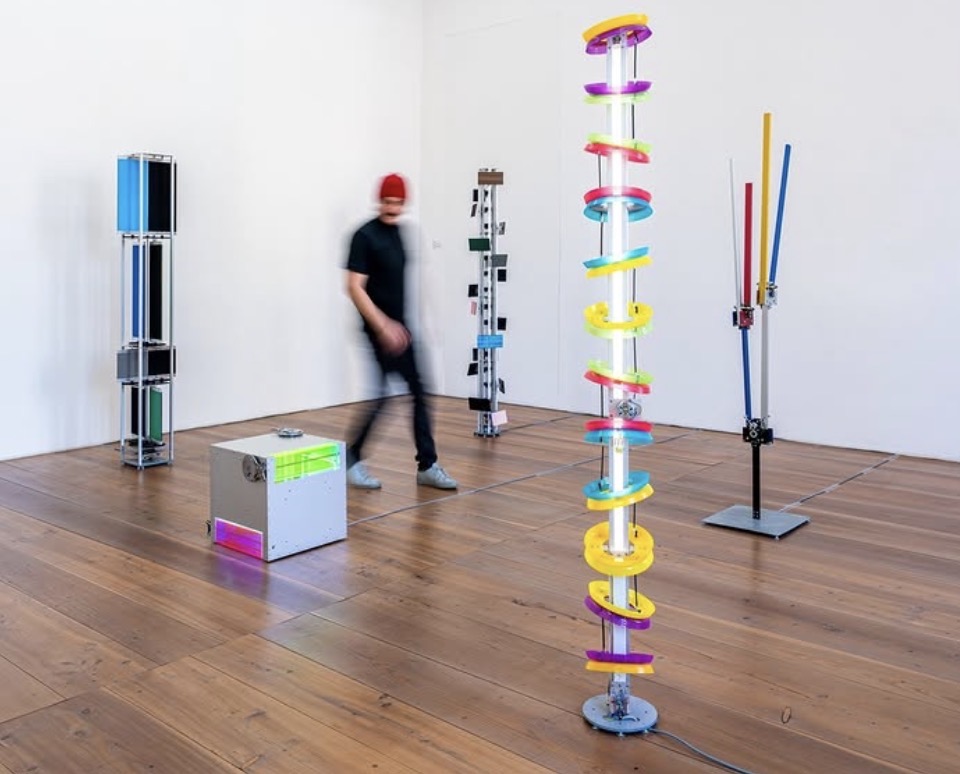
With the work of Siegfried Kreitner, the pavilion is now inhabited by sculptures that appear both technical and poetic. Their matter-of-fact, industrial aesthetic stands in compelling contrast to their silent, barely perceptible internal movement. Restrained, introverted lighting enhances this impression, making the sculptures seem almost like autonomous, living beings.
Like the pavilion’s clean architecture, Kreitner’s sculptures form a deliberate counterpoint to the lush, sprawling greenery of the surroundings. At the same time, their slow pulsation and organic—often circular—movements echo the forms and rhythms of nature. This creates an interplay between the artificial and the organic, between technical precision and living motion. Far from appearing as foreign bodies in the landscape, the sculptures seem to engage with their environment in a subtle way.
SIEGFRIED KREITNER – Minimal-Kinetic Sculptures
During his art studies in the late 1990s, Siegfried Kreitner visited New York City and was deeply impressed by the pulsating metropolis—its urban canyons, skyscrapers, and contemporary art scene. These impressions left a lasting mark on him, serving as an enduring source of inspiration. Initially trained in classical sculpture, the artist turned to these new influences, developing works based on geometric forms and solids—such as cubes and cylinders—as well as other motifs drawn from the architecture of the megacity. His intensive engagement with metal and mechanics was aided by collaborations with friends studying mechanical engineering; to this day, his studio—which functions much like a workshop—houses a lathe and milling machines.
Siegfried Kreitner works within the realms of concrete, constructive, and kinetic art. He is connected to the Minimal Art tradition of American artists Donald Judd and Dan Flavin, as well as the sensitive, technically sophisticated kinetic works of George Rickey, which he first encountered in New York. He unites the key elements of these artists’ work—geometric form, light, and dynamics—in his own creations. He aptly describes his art as “minimalkinetisch” (minimal-kinetic). It slows down the pace of our hyper-technological, digital world through extremely slow movements—motions the viewer perceives only by lingering and observing closely—thereby aiming to captivate the viewer and induce a sense of calm.
Through a minimalist aesthetic, the artist focuses on material, movement, light, and color. He typically creates column-like objects standing around two meters tall; possessing a spatial presence akin to figurative sculpture, they are designed to be viewed from all angles. Viewers are encouraged to walk around them to discover the minimal-kinetic interplay of the individual geometric elements.
Kreitner takes a critical view of a world dominated by technology. He eschews high-tech components—with the exception of LEDs—preferring materials such as acrylic glass, aluminum, and neon tubes, while placing great importance on the clarity and comprehensibility of his art. Initially creating works entirely devoid of color, the artist has for some time been accentuating movable components—crafted from materials such as acrylic glass, anodized aluminum, or foil-covered MDF—with a free use of color. Driven by electric motors (1–5 rpm), the precisely coordinated, visible mechanisms set the elements in motion, creating a delicate interplay of clear forms, colors, and light.
Text for the catalog accompanying the exhibition “vis à vis,” Essing 2026, by
Barbara Leicht, Art Historian and Head of the Cultural Office of the City of Neumarkt