
What is the true role of a gallery? Why must galleries champion unknown artists and take artistic risks? Torsten Obrist discusses the art market, innovation, and responsibility.
In the first part of this series, I described how significantly the role of the gallery has changed. Today, a gallery is no longer merely a place where artworks hang on walls waiting for buyers. It acts as a producer, intermediary, network, communication platform, and—increasingly—a brand. The second part explored why some artists gain visibility while others, despite producing high-quality work, go largely unnoticed. In the third part, we examined how the price of an artwork is determined. This raises another, perhaps even more fundamental question: What should a gallery actually show? Art that is already successful? Or art that might only achieve success in the future?
A gallery cannot rely solely on playing it safe
From an economic standpoint, the first option is naturally tempting. A well-known artist generates attention. Collectors recognize the name. Museums may have already exhibited the work. Critics have written about it. Market prices are established. The risk is relatively manageable.
Yet, this is precisely where a problem arises. If everyone shows only what is already successful, very little that is new emerges. The gallery shifts from a place of discovery to a place of validation. It displays what is already visible. And eventually, the question arises:
What purpose does it serve then?
A gallery must sometimes believe in something before others do
In my more than 25 years of working in galleries, I have repeatedly seen that artistic evolution does not follow a straight line. An artist might be unknown today yet hold a significant position ten years down the line. An exhibition might be a commercial disappointment while remaining artistically important. And sometimes, an apparent failure later proves to be a crucial step forward.
Art often emerges where there is no established certainty yet
That is perhaps the crucial point. Initially, a new artistic position is often difficult to categorize. It does not yet fit into known categories. It lacks an established market. There may not yet be a long exhibition history, museum shows, or major collections associated with it. That does not automatically make it good. But it does mean one has to look more closely. And that is precisely where curatorial work begins.
A gallery must decide:
– Which position is interesting enough to warrant an investment of time and money?
– Which artist’s development merits long-term support?
– Which exhibition is worthwhile, even if it might not be a financial success in the short term?
These are not theoretical questions. An exhibition costs money. An art fair costs money. Publications cost money. Transport, insurance, framing, communications, and staff all cost money. Consequently, when a gallery builds up a young artist, it always assumes a financial risk.
One of my most important lessons: patience
I learned early on that artistic development and financial success do not move at the same pace. Sometimes, an artistic position takes years to make its full impact. The same applies to collectors. Not everyone buys immediately. Sometimes someone sees a work at a fair and only returns to it a year later. Sometimes it takes multiple exhibitions, conversations, and encounters for interest to evolve into a collection. That is why patience is one of the most important qualities for a gallerist.
I would even go so far as to say: A gallery must be willing to invest time that cannot be immediately measured in financial terms. That has become more difficult in today’s “attention economy.”
– Social media demands constant visibility.
– Art fairs generate significant financial pressure.
– Artists are expected to generate attention as quickly as possible.
– And collectors are constantly confronted with new names.
But art doesn’t always work at such a rapid pace.
Visibility is not the same as quality
When an artist frequently appears in the media, maintains a presence at art fairs, and is visible on social networks, an impression of importance quickly emerges. This may be justified. However, it can also simply be an amplification of existing success.
– Those who are visible become more visible.
– Those who are collected become more interesting to other collectors.
– Those who exhibit in museums become interesting to other institutions.
The art market therefore possesses a powerful momentum of its own. A good gallery should understand this mechanism—but not succumb to it entirely. Otherwise, the gallery eventually turns into a mere distributor of names that are already established.
The most compelling question is not: What sells?
Of course, a gallery must operate profitably. A gallery is not a museum or a public institution, after all. It has to pay artists, fund premises, produce exhibitions, and survive economically. Yet the decisive question should not be exclusively:
“What sells?”
But rather:
“Which art deserves to be seen?”
That makes a huge difference. For it is between these two questions that a gallery’s true cultural responsibility lies.
The glass pavilion as a space for experimentation
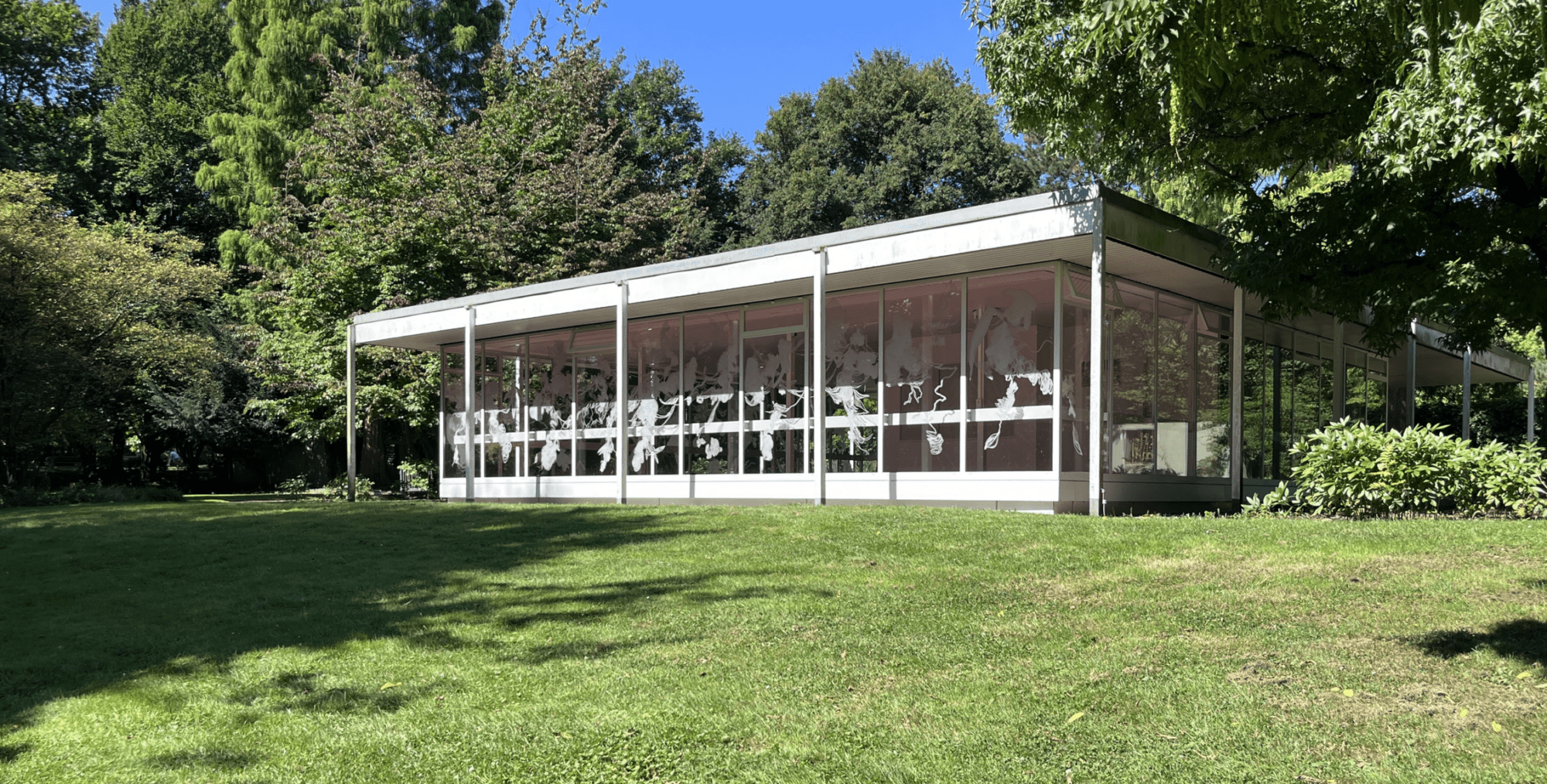
An example of this is my work at the Glass Pavilion in Essen’s Grugapark. The pavilion is an unusual exhibition venue: a transparent, almost entirely glass-walled space that cannot simply be curated like a traditional gallery. For several years, solo shows have been held there in which artists are free to interpret this unique space in their own way. It is precisely these conditions that create something often difficult to achieve in the standard gallery circuit: artistic freedom unconstrained by immediate market logic. The artworks do not have to fit into a pre-existing sales structure; the space itself becomes an integral part of the artistic work. And it is precisely from this dynamic that some of the most interesting exhibitions emerge.
Why this matters for collectors, too
At first glance, this might seem like a topic relevant only to artists and gallerists. Yet collectors benefit as well. If a gallery relies exclusively on established names, the collector’s range of choices inevitably narrows. Conversely, when galleries cultivate new artistic voices, it opens up the opportunity to follow an artist’s development from an early stage. This does not mean that every early purchase will turn into a future success story—that would be a false promise. Rather, it means that collecting art involves developing one’s own opinion and learning to embrace uncertainty. Perhaps that is one of the most rewarding aspects of collecting: not merely owning what is already familiar, but discovering something new.
A gallery shapes the future
I believe that a gallery’s true cultural mission begins where certainty ends. A gallery that shows only art with an established reputation is essentially looking backward; it merely affirms the present. In contrast, a gallery that discovers new artistic voices, takes risks, and supports artists over the long term is actively shaping the future. Of course, this does not always succeed…
There have been times when artists were let go too early or too late, projects failed, and exhibitions proved to be financial disappointments. Yet such experiences are an inherent part of gallery work. After all, if a gallery never fails, it is likely never taking any real risks.
And so, for me, the decisive question is not:
Which art wins?
But rather:
Which art would have even had the chance to become visible without the risk taken by a gallery?