
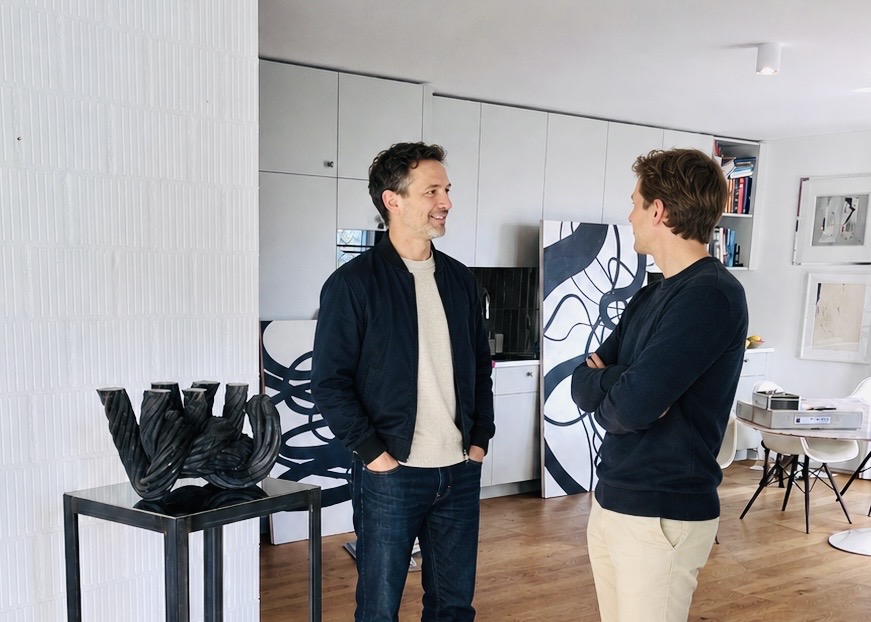
Why do people buy art? How do trust, a sense of security, and conviction develop when purchasing art? A gallerist explains why good advice matters more than sales pressure.
Many people looking to buy a work of art for the first time start by asking themselves a seemingly simple question:
“Is this artwork worth the price?”
That is understandable. Yet, it is not actually the most important question. Buying contemporary art involves something far harder to measure than most other goods: personal conviction. An artwork has no objectively calculable utility value. It doesn’t drive like a car. It doesn’t speed up tasks the way a computer does. And even the cost of materials reveals little about its actual value. As I described in the third part of this series, an artwork’s price arises from a multitude of factors—ranging from artistic quality and the evolution of an artist’s practice to exhibition history, inclusion in collections, and institutional visibility. But even when all this information is known, one crucial question remains: Why do I actually want to own this work?
Many people buy a sense of security first
I often encounter a certain sense of uncertainty, especially when someone is buying art for the first time.“Am I allowed to like this?”
“Is the artist truly important?”
“What do others say about it?”
“Is the price reasonable?”
“What if I get tired of looking at it in a few years?”
These are not unusual questions. On the contrary: they demonstrate that buying art is a deeply personal act. After all, when someone buys art, they are not merely choosing an object; they are choosing to incorporate that object into their personal environment for the long term. It becomes part of a space, a collection, and often one’s own personal history.
That is why buying art is always an act of trust.
Trust in the work. Trust in one’s own perception. And, not least, trust in the person facilitating the acquisition.
A gallery’s role is not to pressure someone into buying
Good art consultation works differently than traditional sales advice. It is not about quickly enticing a visitor to buy a specific piece. It is about discovering what truly interests them about art. Sometimes it is a specific color. Sometimes a shape. Sometimes an idea. Sometimes an artist’s biography. And sometimes, initially, it is none of these things. A visitor might stand before a work without being able to articulate exactly why it appeals to them. That is precisely when the interesting dialogue begins.I do not believe in dictating to visitors what they should see. Of course, I can explain the background, point out connections, or outline an artist’s development. But ultimately, a work of art must stand on its own, without my help. The initial reaction belongs to the viewer; the information comes later. This is a fundamental difference between art mediation and sales pressure.
Your first art purchase doesn’t always have to be the “right” one
When people start collecting, they sometimes think they need to immediately acquire a particularly significant or renowned work. I consider this a mistake. Curiosity is the best starting point for collecting art. Look at a variety of art. Visit exhibitions. Go to art fairs. Compare artists and artistic approaches. Ask questions if there is something you don’t understand. And above all: Observe which artworks continue to occupy your thoughts after some time has passed.After all, a good work of art does not always have to please at first glance. Some pieces are immediately accessible. Others require time. Still others are initially unsettling—and become interesting precisely for that reason. This is one of the reasons why I consider the physical experience of art so important. A reproduction on a screen can provide information, but it cannot fully replace the actual encounter with a work of art. Size, material, surface, spatial effect, and light alter our perception.
Collectors rarely buy just one picture
Over time, one’s perspective on art often shifts. An initial purchase can spark an interest in a specific artist. That artist can become the foundation of a collection. Eventually, one stops looking merely at individual works and begins to see connections. A collector does not simply buy multiple pictures; they develop their own unique perspective on art. Some collectors focus on a particular generation, while others concentrate on photography, sculpture, painting, or media art. Some are drawn to color and form, others to political or social themes. And some follow a single artist over many years. I find that particularly fascinating, because a collection is ultimately a story about its owner. It reveals what interests a person, what occupies their thoughts, and sometimes even the questions they ask themselves.Quality takes time
That is precisely why I advise taking a long-term view when buying art. You don’t have to love every work immediately. Not every artist needs to be represented in a museum yet. And not every interesting artist is already famous. Conversely, fame alone is no guarantee of quality. As we saw in the second part of this series, visibility arises from a complex interplay between artists, galleries, collectors, institutions, critics, the media, and art fairs. Anyone collecting art should therefore learn to distinguish between attention and quality. This does not mean ignoring the art market—quite the opposite. It means understanding it better.
What a good gallery should provide
In my view, a gallery should do more than simply offer artworks for sale. It should provide guidance. It should support artists over the long term, explain contexts, and build trust. It should also be able to tell a collector, “I wouldn’t recommend this work to you.” After all, a strong, lasting relationship between a gallery and a collector is not built on maximizing sales volume. It arises from credibility.
Perhaps this is the single most important prerequisite for buying art:
You do not have to buy a work simply because someone tells you it is important.
You should buy it because you are personally convinced of it. And if a gallery can help foster that personal conviction, it has fulfilled its true purpose.