

Showing 9–16 of 16 results
-

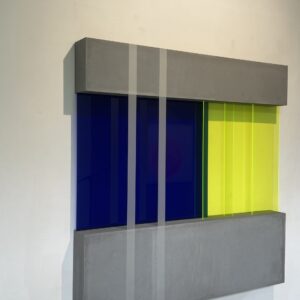
Annette Sauermann: Wandrelief o.T.
13.900,00 € Details -
Siegfried Kreitner: I 2025
7.800,00 € Details -
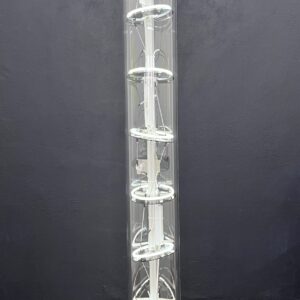
Siegfried Kreitner: V 2014
7.600,00 € Details -
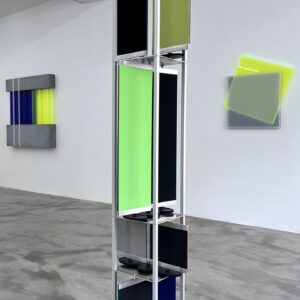
Siegfried Kreitner: III 2022
8.000,00 € Details -
Siegfried Kreitner: IX 2017
8.000,00 € Details -
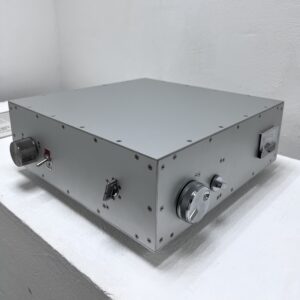
Siegfried Kreitner: VI 2025
3.800,00 € Details -
NOT AVAILABLE!
Siegfried Kreitner: III 2025
3.600,00 € Details -
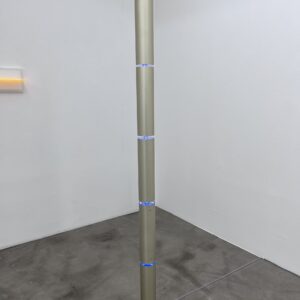
Siegfried Kreitner: VII 2025
3.400,00 € Details

Exhibition opening Friday, September 5, 2025, 7 p.m.
Exhibition runs until October 4, 2025.
About the Exhibition
This is the gallery’s third exhibition dialogue this year, bringing together two artists who have not previously exhibited together. In this case, that’s not entirely true, as Kreitner and Sauermann have already appeared together in group exhibitions at the Ladenburg gallery of the recently deceased gallerist Linde Hollinger. Nevertheless, the gallery had long wanted to bring the works of these two artists together in a joint exhibition, which has now culminated in this excellent exhibition dialogue.
In the gallery space, the two positions are easily distinguishable: Siegfried Kreitner’s objects are in the room, while Annette Sauermann’s are on the wall. Another distinction is that all of Kreitner’s objects are in motion and illuminated as soon as the power is switched on. Movement is also indirectly present in Annette Sauermann’s objects, as ambient light plays a crucial role in her work, and this is, of course, in continuous motion, entirely without motors. And their light, too, requires no electricity and is generated solely by ambient light and the fluorescent materials.
Siegfried Kreitner
The Lower Bavarian artist creates kinetic sculptures with unparalleled precision. He is one of the most important artists in this field in Germany and has participated in numerous exhibitions, including many institutional ones. His works can be found in renowned collections, such as the Museum Ritter in Waldenbuch and the Peter C. Ruppert Collection in Ingolstadt.
Bizarre machines stand in the room, their movements very slow, barely perceptible. What are they for, and what can they do? These questions defy any practical application, and they simply stand as symbols of mechanical or physical laws. The mechanisms interlock precisely and follow a meticulously planned cycle of movement.
The exhibition presents three groups of works: First, there are the pieces with the moving neon light rings (example V 2014). Each ring moves slowly up and down around its rigid central axis, like a boat rocking in the waves. At one brief point, all the neon rings are parallel, one above the other, before they resume seemingly irregular, counter-rotating movements: order and chaos are united in this system.
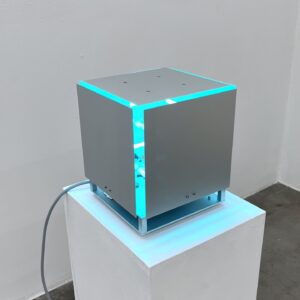
As an example of a second group of works, a silver cube (VII 2025) is on display, its walls shifting slightly back and forth, revealing a mysterious blue light inside. From a distance, it resembles a fairytale treasure chest from which luminous gemstones or a magical glass sphere twinkle. The source of this glow remains unseen. Viewers ask how and why—curiosity and suspense fill the room. Only upon closer inspection, through the opening and closing edges, does the secret reveal itself, offering a glimpse of the fluorescent tubes and the mechanics: technology and poetry unite in a wondrous way.
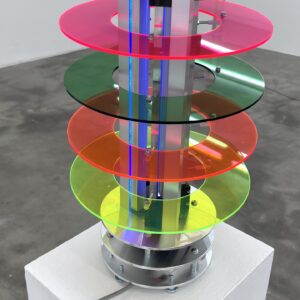
The third example is a work over two meters high (III 2022), in which colored panels rotate and shift against each other at different speeds by means of a complex mechanism. The view is in a constant, seemingly uneven, flux, continually revealing new compositions and color harmonies. Individual views are reminiscent of El Lissitzky’s constructions or Mondrian’s clear color weightings, but it is not a static image; rather, a great multitude of such images, united in a single object, unfolds in temporal succession.
The entire mechanism of the object is visible—motors, gears, power supply, and cables—and so we attempt to physically trace the rhythm and the changing arrangement. Kreitner’s machines appear as if they could have come from modern robotics research, but they are the exact opposite of robots; they do not serve and they fulfill no purpose. Kreitner’s mechanical organisms are self-sufficient; they are limited to their very existence, dependent solely on electricity.
Annette Sauermann
The wall-mounted objects by Annette Sauermann are juxtaposed with the objects in the room. For 35 years, the Aachen-based artist, born in Essen, has been exploring the theme of light in her art. She has had numerous exhibitions in Europe and the USA. She has also realized many public art projects, most recently a 6-meter-high light stele at the University Hospital of Cologne.
Her multi-part works in the exhibition consist of a central structure and mostly self-illuminating monochrome color panels, which, through transparencies and overlaps, create new fields of color. The fluorescent edges of the color panels produce sharp lines that luminously contour the overall image.
Her largest work in the exhibition (untitled wall relief, inventory no. 19010) refers to an earlier stage of her work through the use of concrete. In this piece, several yellow panels and one blue panel are set between two concrete blocks. The arrangement of the panels creates various yellow fields, a large blue field, and a narrow green strip. These fields are defined by the edges of the panels, which form fine vertical lines, creating a vertical layering effect. Furthermore, two transparent strips stretch across the entire height of the left half of the image, reinforcing this structure and adding another layer to the composition. Annette Sauermann uses concrete, plexiglass, and light filters, but the primary material is light, which she manipulates and virtually models through the arrangement of the panels and the light filter. The concrete, as a light-absorbing material, creates the physically perceptible top and bottom boundaries of the image. She dispenses with this boundary in her more recent works, which she calls “Lighttransformers.” For example, in Sauermann’s latest work, Lighttransformer 1A, Circle and Square, the light is intended to spread in all directions beyond the confines of the image. A circular shape interlocks with a square base, but these are only vaguely discernible due to the use of white satin-finished material on the wall. At the intersection of the square and circle, however, vibrant, sun-yellow circles of varying sizes overlap, creating a kind of explosion of light emanating from within.
The use of the simplest, most unadulterated basic forms with a limited palette and their structuring through luminous lines has been a recurring theme in Annette Sauermann’s work in recent years. The exhibition showcases various other works in which she explores this approach with altered colors and formats. Sauermann embarks on a creative quest for the fundamental principles of light, form, and color, as others before her have surely done, such as Theo van Doesburgh or Wassily Kandinsky. However, she has found a form of expression that is unique in its materiality and minimalist gesture: Annette Sauermann’s works are instantly recognizable.
The exhibition’s title, LIGHT IMPULSE, derives from the above: movement and light are the central themes, and these two motifs are intended to prompt visitors to look closely and have unique sensory experiences. Viewed in this way, the exhibition is, in the truest sense, an immersive experience.