

BETWEEN STUDIO AND MARKET (1) — What Does a Gallery Actually Do These Days?
The Role of the Gallery in the Digital Art Market – Many people still imagine a gallery as a place where artworks hang on the…
BETWEEN STUDIO AND MARKET (3) – How is the price of an artwork determined?
Many visitors wonder why one artwork costs a few hundred euros while other pieces command five-figure prices. The answer does not lie in the cost…
BETWEEN STUDIO AND MARKET (4) – Why Art Is a Purchase Based on Trust
Why do people buy art? How do trust, a sense of security, and conviction develop when purchasing art? A gallerist explains why good advice matters…
As a gallery owner, I’m often asked how the price of a work of art is actually determined. The short answer is: it doesn’t happen by chance – nor is it arbitrary. The longer, and more important, part is that behind every price lie a multitude of factors that together create a coherent whole.
First, there’s the artist’s own position. A work of art always bears the signature of a person – their training, their development, their exhibition history. Has the artist already exhibited in museums? Is there international exposure, reviews, collections in which their work is represented? All of this influences its market positioning. It’s not just about “fame,” but about traceability and consistency.
A second, often underestimated point is the quality of the artwork. Material, technique, and execution play a crucial role. A large-format painting with elaborate layering, high-quality pigments, and a long creation time is not comparable to a quick study. Uniqueness also counts: A one-of-a-kind piece naturally has a different value than a limited edition.
The work’s context is also important. Does it belong to a significant series? Does it mark a turning point in the artist’s career? Is it particularly representative? Such aspects are crucial for collectors because they help determine a work’s long-term value.
Another key element is the gallery itself. Our task is not only to present artworks, but also to develop artists over many years: organizing exhibitions, cultivating relationships with institutions, supporting publications, and creating international visibility. This ongoing work is reflected in our pricing structure – transparently and comprehensibly.
Last but not least, the market also plays a role. Supply and demand, comparative data, auction results, and general trends in the art market provide a framework. A responsibly managed gallery ensures that prices develop stably and consistently – not erratically, but with a focus on sustainability.
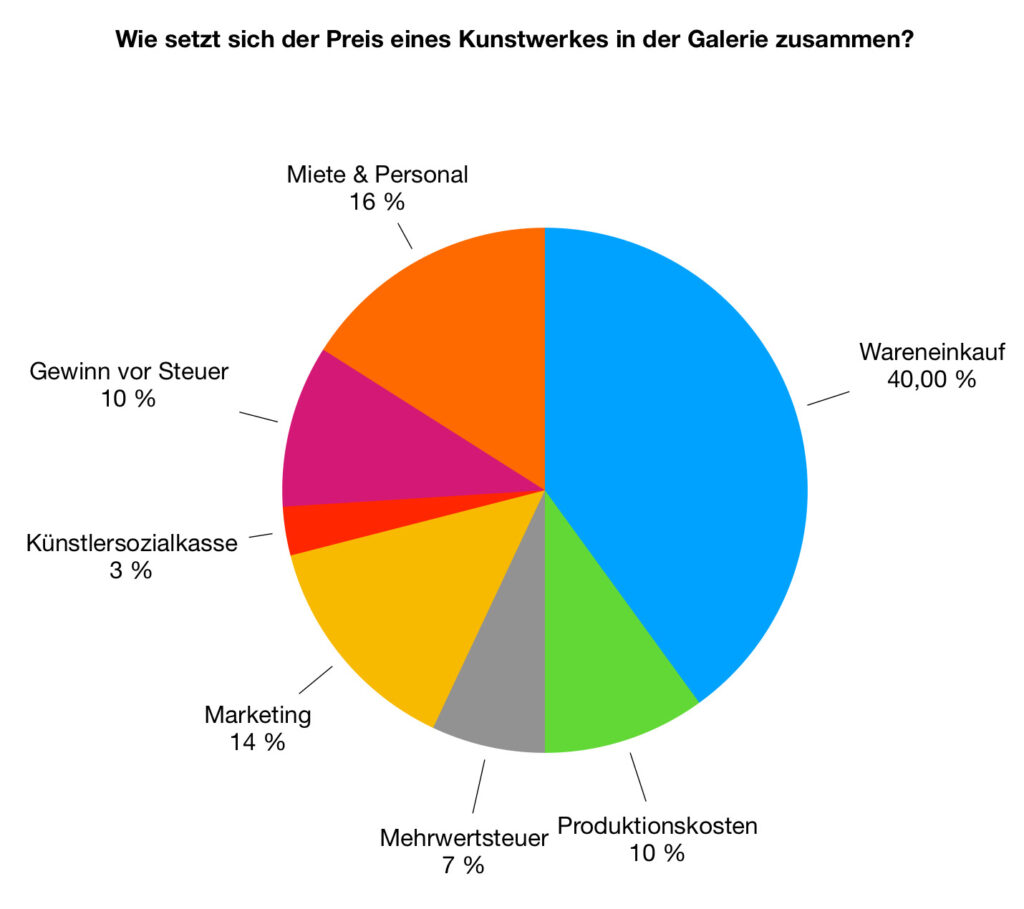
The diagram illustrates how a gallery’s selling price is composed of various components: artist’s fee, gallery work, production costs, taxes, and other factors. I deliberately include this diagram in this article because it creates transparency—and because I am convinced that trust arises from understanding.
It’s important to me that you feel confident in your purchase decision. A work of art is never just an object – it’s a long-term relationship. And like any good relationship, it begins with clarity.
If you have questions about a specific work or would like a personal assessment, please feel free to contact me. I will take the time to understand your perspective and explain the background in detail.
Or let us provide you with individual guidance in building your collection…